The $2 Trillion SaaS Reckoning
What PE investors must understand about the AI-driven bifurcation of SaaS — and the generational buying opportunity it creates.
The $2 Trillion SaaS Reckoning: What PE Investors Must Understand Before It's Too Late
An executive briefing distilled from JABB Fusion's 9-chapter deep research report on the AI-driven bifurcation of SaaS — and the generational buying opportunity it creates.
On February 3, 2026 — a date traders now call "Black Tuesday for Software" — Anthropic released Claude Cowork, a suite of autonomous AI agents capable of executing legal contract reviews, financial triage, and enterprise workflows without human oversight. The market reaction was instantaneous: $300 billion in software market capitalization evaporated in 48 hours. The S&P 500 Software Index dropped 5.7% in a single session, its worst day in years. By mid-February, the iShares Expanded Tech-Software Sector ETF had plunged into a technical bear market, down 24.6% year-to-date.
Salesforce fell 29%. HubSpot crashed 39%. Figma plunged 40%. Atlassian dropped 35%.
The headlines screamed "SaaSpocalypse." Traders declared the death of software-as-a-service.
They were wrong — but not entirely.
Generative AI is not killing SaaS. It is bifurcating it. And this bifurcation — the largest valuation dispersion in the history of enterprise software — is creating both a graveyard for undifferentiated tools and a generational buying opportunity for investors who can tell the difference.
This article distills the core findings from our comprehensive 9-chapter research report into a single, actionable briefing. If you invest in, operate, or advise SaaS companies, what follows will reshape how you think about every deal in your pipeline.
The Sell-Off Was Indiscriminate. The Disruption Is Not.
The February sell-off conflated three distinct phenomena into one blunt narrative:
-
Cyclical multiple normalization — the inevitable unwind from 2021's zero-rate-fueled 15x+ revenue multiples. This was happening regardless of AI.
-
Structural growth deceleration — median public SaaS revenue growth fell to 12.2% by Q4 2025, the lowest on record. Mature SaaS is slowing.
-
Genuine AI disruption risk — the new variable. AI agents that can log interactions, update records, score leads, and generate pipeline reports are making the manual data entry that justified CRM seat licenses the first workflow to be fully automated.
The market treated all three as one story and punished everything. But the data tells a very different story:
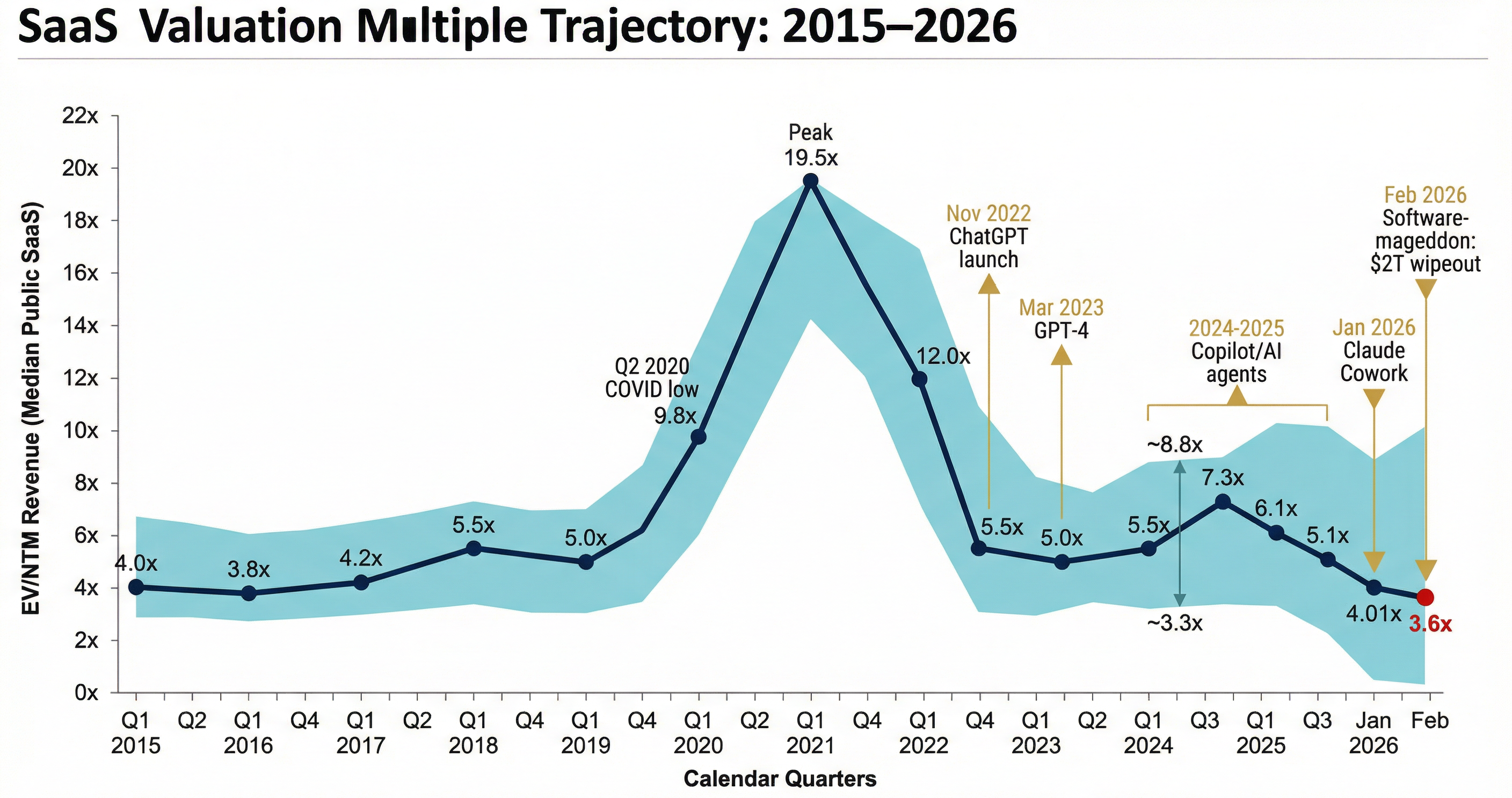
Data Infrastructure software trades at 6.2x NTM revenue and 24.4x EBITDA. DevOps commands 36.5x EBITDA. Meanwhile, Sales/Marketing Automation has compressed to 1.9x revenue, and AdTech sits at 1.1x.
That's a 5–6x spread between the most and least valued categories — and it's widening. The market is differentiating with increasing precision between software that AI makes more valuable and software that AI makes obsolete.
As Vista Equity Partners CEO Robert Smith put it: "Investors are asking a reasonable question: what role does enterprise software play in a world where AI can do so much? We believe the narrative is wrong, but it's not irrational."
Bank of America offered an even sharper critique: the sell-off relies on two mutually exclusive scenarios — "AI capex deteriorating to the point of weak ROI" and "AI adoption so pervasive it makes all software obsolete." Both cannot be true at the same time.
The right question is not "Is AI killing SaaS?" It is "Which SaaS, and how fast?"
The New SaaS Economics: Two Archetypes, Two Futures
AI simultaneously compresses some costs, inflates others, destroys certain revenue streams, and creates new ones. The net effect splits SaaS into two fundamentally different economic trajectories.
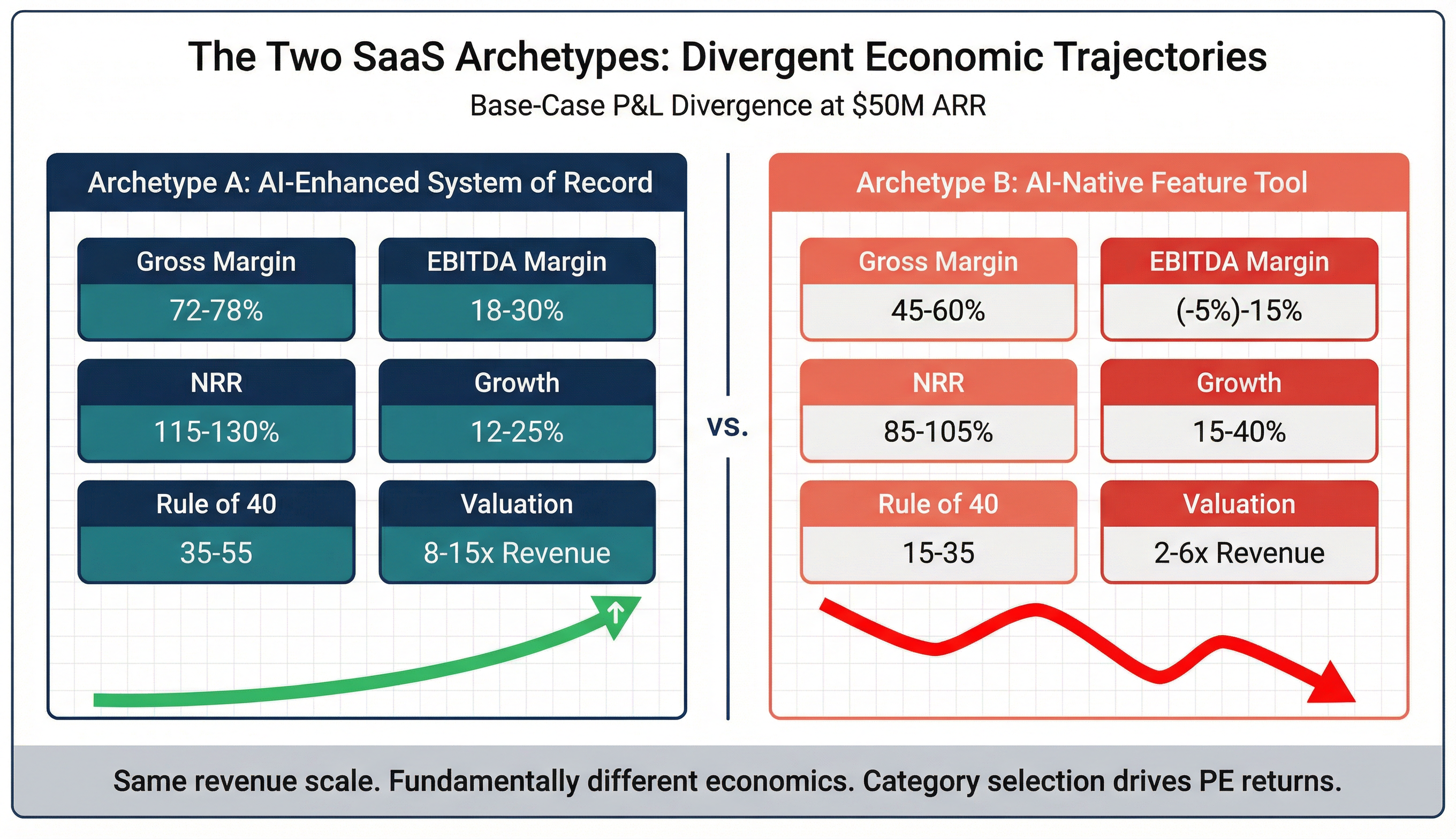
Archetype A: The AI-Enhanced System of Record
An established SaaS platform with deep data moats, regulatory compliance, and high switching costs layers AI features onto its existing product. Gross margins compress modestly (5–10 points) as selective AI features introduce compute costs. But operating expenses decline dramatically as AI automates support, accelerates R&D, and improves sales efficiency. The net effect: EBITDA margins expand by 500–1,500 basis points. Pricing evolves to hybrid models, expanding revenue per account by 10–30%.
Projected EBITDA margin: 18–30%. Rule of 40 score: 41+.
Archetype B: The AI-Native Feature Tool
A new SaaS entrant competing primarily on AI-powered features faces structurally different economics. Gross margins start at 50–65% due to inference costs. Heavy R&D spend is needed to maintain feature parity in a rapidly commoditizing market. Price competition erodes pricing power.
Projected EBITDA margin: -5% to 15%. Rule of 40 score: 37 (at best).
The implied enterprise value difference between these archetypes — potentially 2–3x at the same revenue scale — illustrates why the blanket "AI kills SaaS" narrative is as wrong as the blanket "SaaS is safe" narrative.
A critical hidden cost PE firms must internalize: AI costs are often poorly tracked and systematically underestimated. Vendors lure customers with generous pilot credits, yet scaling to production routinely reveals 500–1,000% cost underestimation. Only an estimated 15% of companies can forecast their AI spend within ±10%.
The Five-Category Risk Spectrum: Where Your Portfolio Sits
Our research segments the entire SaaS landscape into five categories with radically different AI exposure profiles. This is the report's central analytical framework — and the tool that turns the indiscriminate sell-off into a precision investment map.
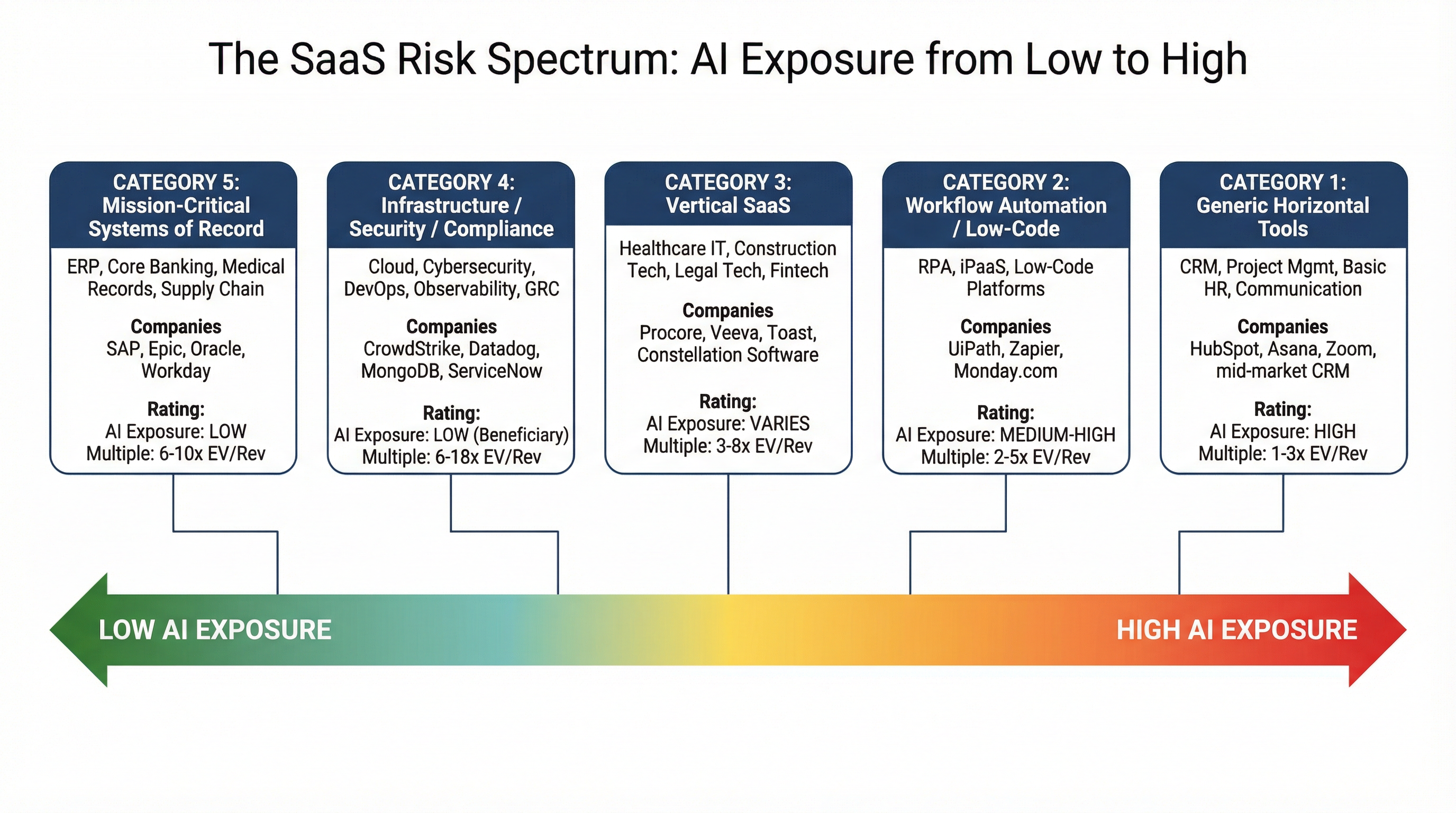
Category 1: Generic Horizontal Tools — HIGH Exposure
CRMs, project management platforms, basic HR tools, communication suites. These were the canonical SaaS success story of the 2010s. They are the most exposed category in the AI era.
The barrier to building competitive alternatives has collapsed. AI agents directly substitute for the human workflows these tools support. As Microsoft's Satya Nadella stated, business applications "are essentially CRUD databases with a bunch of business logic" — and in the agent era, "the business logic is all going to these agents."
If AI agents can do the work of 100 sales reps, the customer doesn't need 100 Salesforce seats — they need 10. That's a 90% reduction in seat revenue.
Category 2: Workflow Automation / Low-Code — MEDIUM-HIGH Exposure
A paradoxical position: these tools were designed to democratize automation — the very capability generative AI now delivers natively. Simple automation faces existential pressure. Enterprise orchestration retains value but is being redefined.
Category 3: Vertical SaaS — VARIABLE (This Is Where Precision Matters)
This is the category where the most analytical precision is required — and where the biggest mispricing exists.
Surface-level vertical tools (basic scheduling, simple billing, lightweight trackers) are as exposed as any horizontal tool. They are features, not platforms.
Deeply embedded vertical platforms (systems of record for their industry, handling regulatory compliance, controlling physical-world workflows) retain strong and potentially strengthening defensibility. The Procore case study is instructive: the platform evolved beyond tracking progress — it became the system controlling financial management, bidding, and legally mandated audit trails. If Procore goes down, capital can't be deployed and compliance is jeopardized. Its gross revenue retention: 95%.
Constellation Software — the most successful acquirer of vertical software in history — has compounded at 36% CAGR since its 2006 IPO. Its management addressed AI fears with a balanced view, noting their acquisition underwriting already reflects technological change. They are increasing acquisition spend to $2.25 billion by 2029.
Category 4: Infrastructure / Security / Compliance — LOW Exposure (AI Beneficiary)
This category is not merely resilient to AI disruption — it is a direct beneficiary. More AI means more infrastructure to monitor, more security risks to defend against, and more compliance requirements to satisfy. Cybersecurity spending is projected to exceed $520 billion annually by 2026.
Category 5: Mission-Critical Systems — LOW Exposure (The Fortress)
ERP, core banking, electronic medical records. AI agents need these systems, not the other way around. Switching costs are immense. Replacing an SAP or Epic implementation is "open-heart surgery for an enterprise."
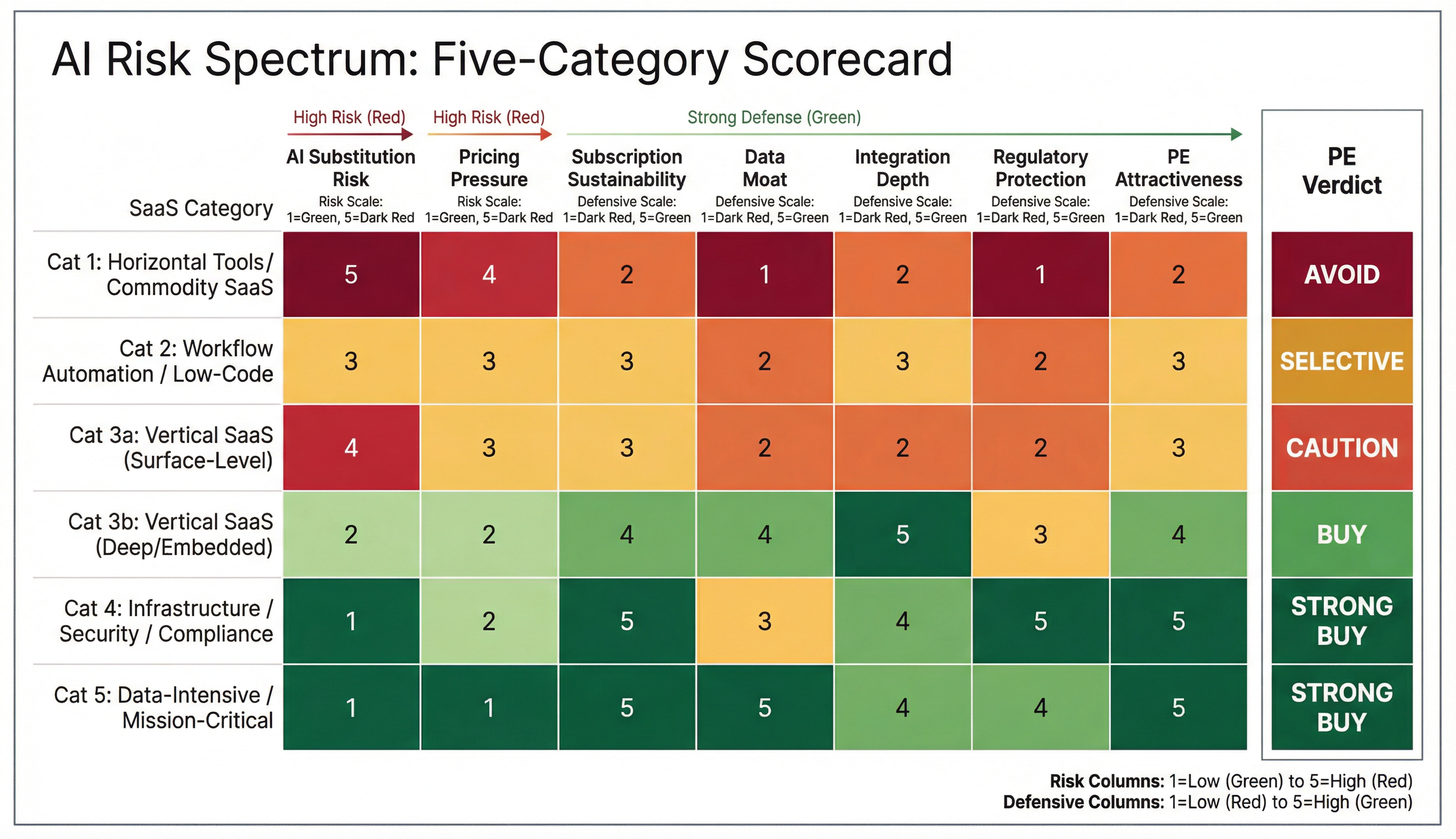
| SaaS Category | AI Substitution Risk | PE Attractiveness |
|---|---|---|
| Generic Horizontal | 5.0 (Highest) | 1.5 (Lowest) |
| Workflow / Low-Code | 3.5 | 2.5 |
| Vertical SaaS (Surface) | 4.5 | 2.0 |
| Vertical SaaS (Deep) | 2.0 | 4.5 |
| Infrastructure / Security | 1.0 | 5.0 |
| Mission-Critical Systems | 1.5 | 4.5 |
Scale: 1 = lowest risk/highest defensibility, 5 = highest risk/lowest defensibility.
What Remains Defensible: Five Moats That Survive AI
Not all moats are created equal in the AI era. Our research identifies five specific defensibility mechanisms — and one critical test that separates real software companies from AI wrappers.
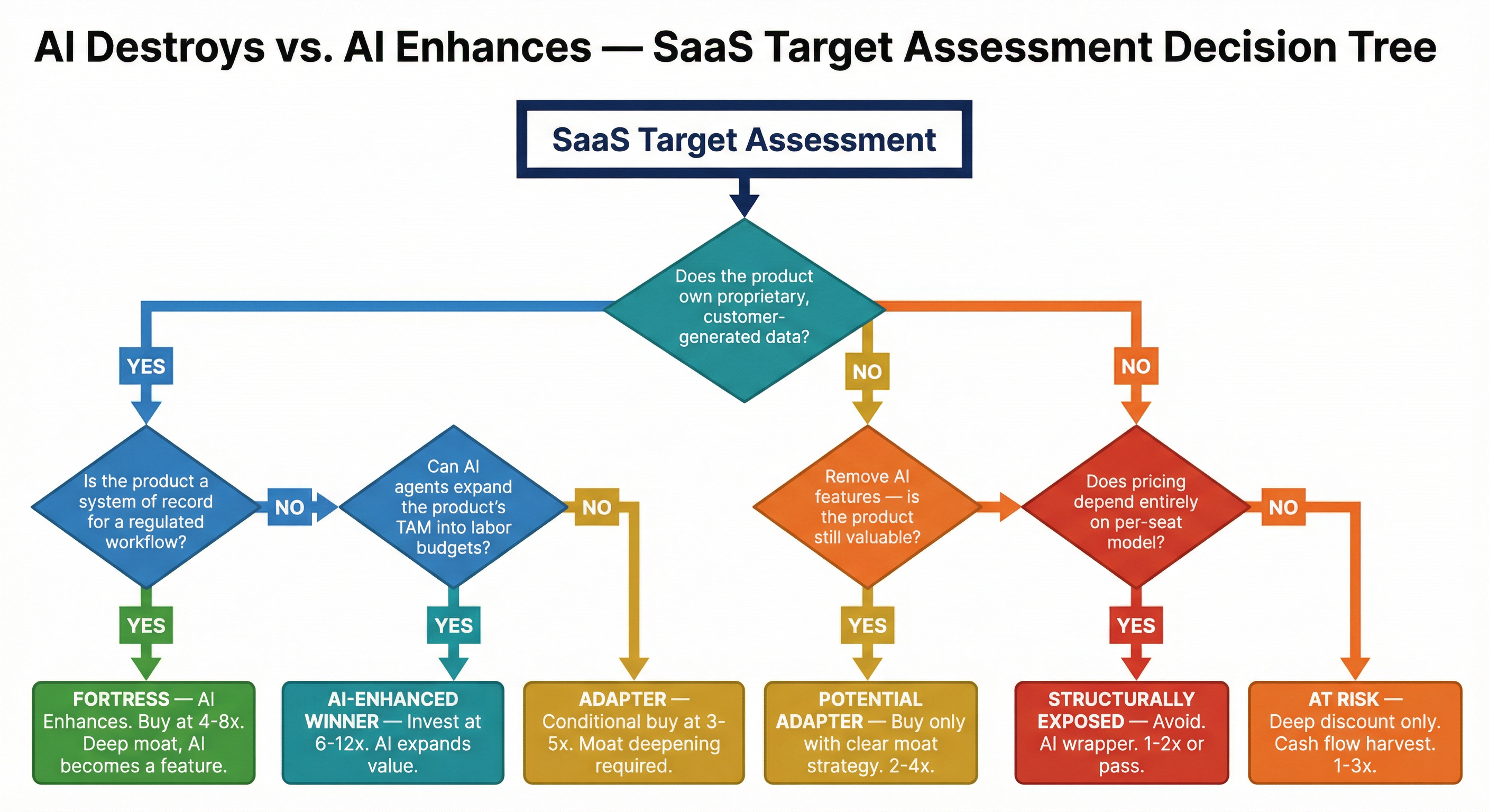
1. Proprietary Customer-Generated Data. Not generic data (AI has commoditized that), but data created by customers using your product — treatment outcomes in a healthcare EMR, project histories in construction management, transaction patterns in a fintech platform. This data compounds over time and cannot be replicated by training a foundation model on public data.
2. Deep Process Integration. When your software controls physical operations, money flows, or compliance — replacing it means rewiring the physical world, not just migrating data. Integration at Level 3–4 (workflow control and system-of-consequence) resists AI erosion.
3. Regulatory Lock-In. In regulated industries, software becomes the official, auditable system of truth. AI actually increases regulatory complexity, creating more demand for compliance software. Only 22% of enterprises prioritized AI governance policy in 2025 — this gap is a massive opportunity.
4. Security and Trust Requirements. Enterprise buyers prioritize proven reliability over cutting-edge features. Shadow AI risks are high — IBM found that organizations with high levels of shadow AI saw $670,000 in additional average breach costs.
5. Ecosystem Switching Costs. Over 90% of Salesforce customers use at least one AppExchange app. When vendors, customers, and partners align around a shared platform, switching disrupts an entire network of relationships.
The Wrapper Test: One Question That Changes Everything
"If you removed the AI features from this product, would it still be valuable to customers?"
If YES: The AI is enhancing an existing moat. The company has intrinsic value independent of AI. This is structurally defensible software.
If NO: You are looking at an AI wrapper. The product's entire value depends on capabilities built on third-party models, delivered through commodity compute, and replicable by any competitor. 90% of AI startups are projected to fail by 2026 due to unsustainable economics and weak competitive moats.
Four Scenarios, One Base Case: The Largest Valuation Spread in History
Our research models four scenarios for how SaaS valuations evolve from 2026 through 2031. The base case — Polarization at 45–55% probability — is the scenario that demands the most nuanced response.
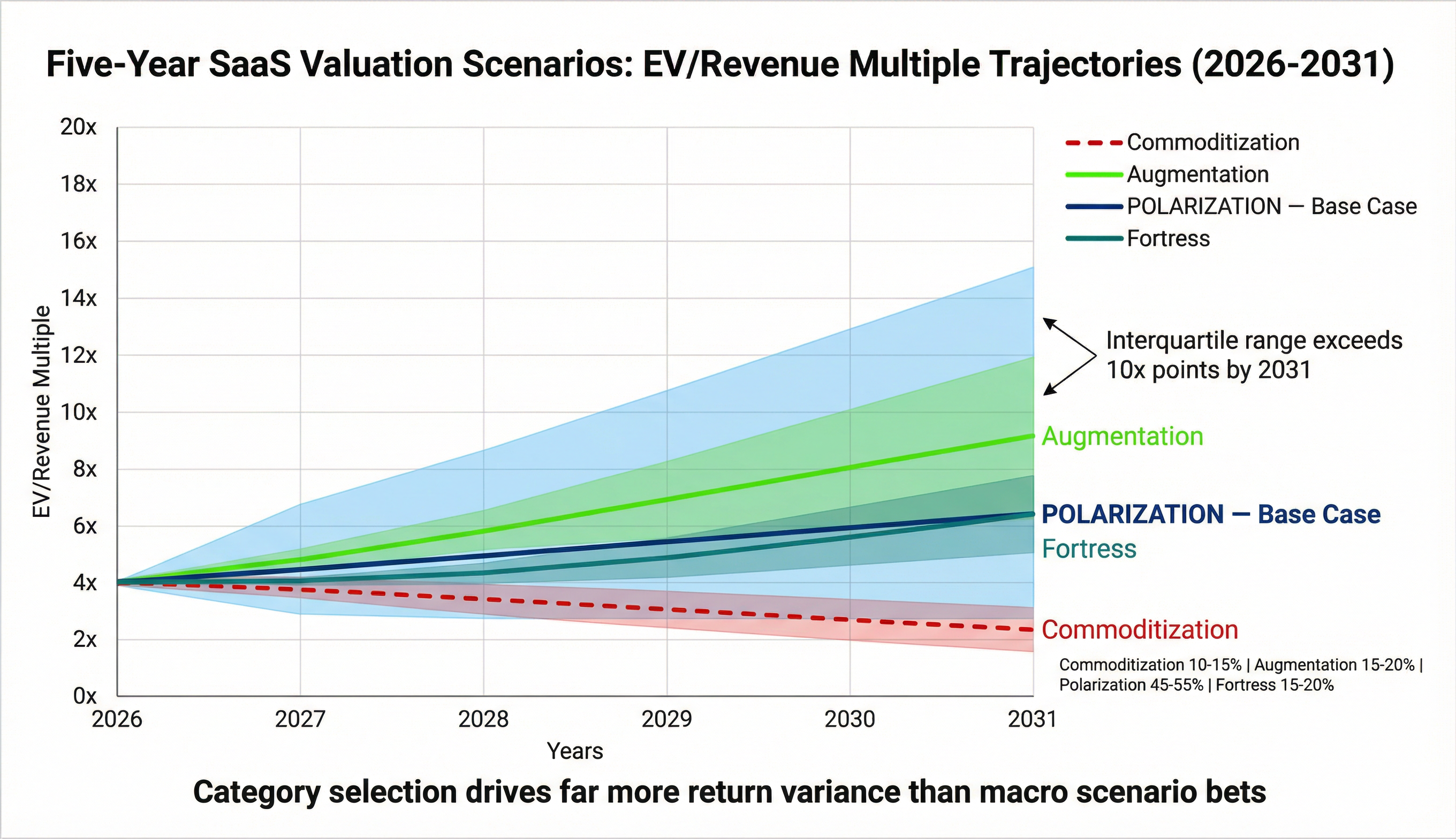
| Scenario | Probability | Median EV/Rev 2031 | Top Quartile | Bottom Quartile |
|---|---|---|---|---|
| Commoditization ("Software Deflation") | 10–15% | 2.0–3.0x | 4.0–6.0x | 0.5–1.5x |
| Augmentation ("Rising Tide") | 15–20% | 8.0–10.0x | 15.0–20.0x | 4.0–6.0x |
| Polarization ("Winners & Losers") | 45–55% | 5.0–7.0x | 12.0–18.0x | 0.8–2.0x |
| Fortress ("Regulated Resilience") | 15–20% | 5.5–7.5x | 10.0–15.0x | 2.0–4.0x |
The defining feature: under the base case, the gap between top-quartile and bottom-quartile SaaS multiples widens to 10–16x by 2031 — the largest dispersion in the history of the SaaS sector.
Category selection will drive 80% of PE returns. Investing in the right category at the wrong time produces better returns than investing in the wrong category at the right time.
Three Winning Archetypes: Where to Lean In
Our research identifies three specific archetypes where SaaS companies don't merely survive AI — they are structurally strengthened by it.
Archetype 1: The System of Record That Becomes an AI Hub
AI agents are useless without access to the data within existing SaaS platforms. If you own the system of record, you don't fear AI agents — you become the platform they operate on.
Salesforce's Agentforce reached nearly $1.4 billion in ARR, up 114% year-over-year, with 18,500 customers — the fastest-growing organic product in the company's history. Workday launched its Agent System of Record. SAP introduced 14 new Joule Agents across enterprise functions.
Archetype 2: The Vertical Platform That Deepens Its Moat
Vertical AI engines trained on proprietary data outperform general-purpose models. AI increases regulatory complexity, creating more demand for compliance software. Community-driven switching costs (you can clone a codebase in a week; you cannot clone a network of 500 high-level CFOs who trust each other) resist AI disruption. Physical-world integration creates barriers that pure software cannot overcome.
Archetype 3: The AI-Enhanced Company That Captures New TAM
Traditional SaaS competed for 3–5% of enterprise revenue (IT budgets). AI-enhanced SaaS that automates human labor competes for 30–50% of revenue (labor budgets). The addressable market expansion is an order of magnitude.
Ramp reached $1B+ ARR by October 2025 — zero to a billion in under five years — by pricing against labor costs, not software budgets. Adobe exited Q1 2025 with $125M in standalone AI product revenue. Vista Equity's LogicMonitor generates $2M annual savings per customer through its agentic AI solution.
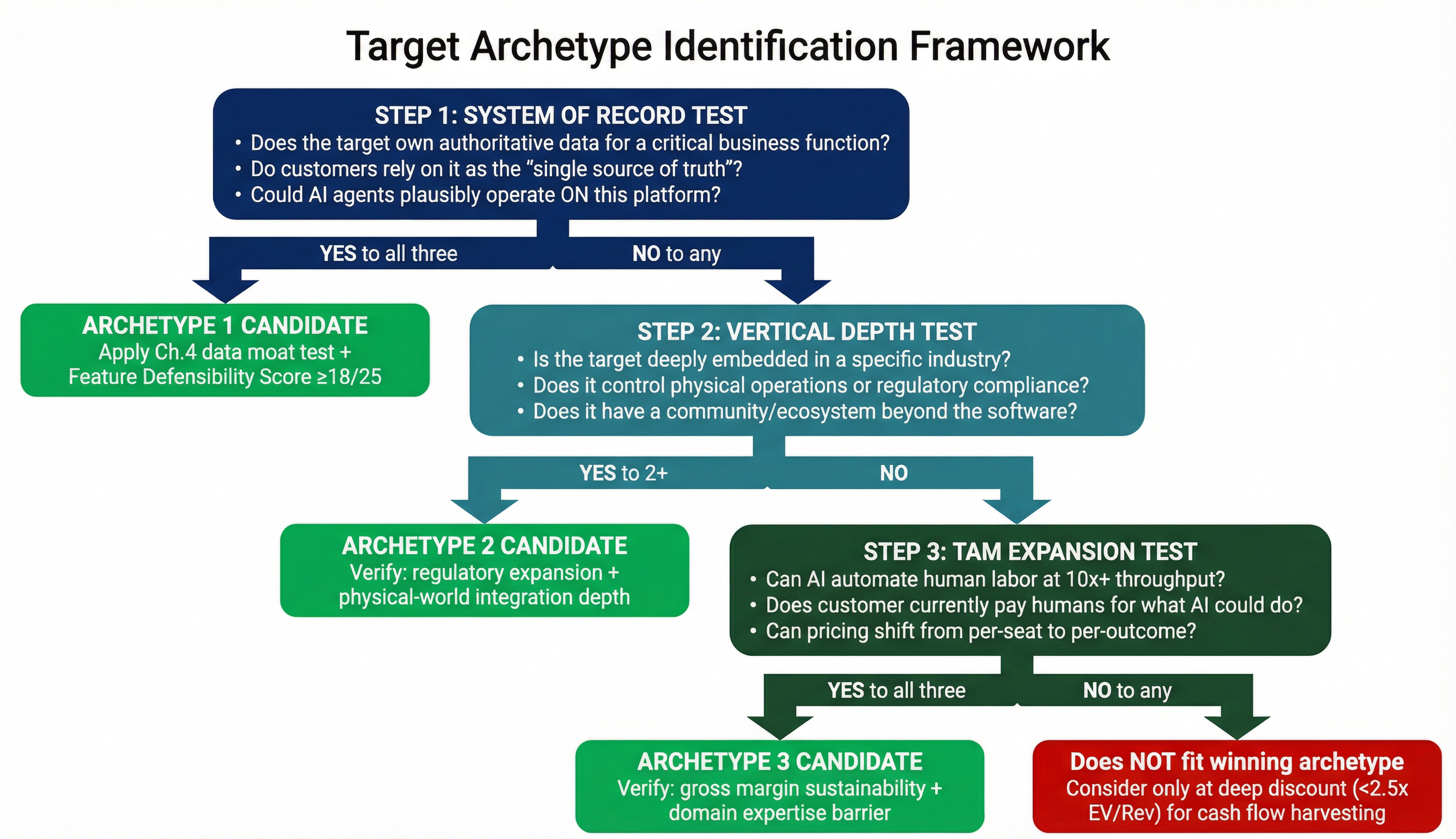
| Archetype | Current EV/Rev | Polarization Base 2031 | Key Value Driver |
|---|---|---|---|
| System of Record → AI Hub | 3.5–5.5x | 7.0–12.0x | AI monetization + platform expansion |
| Vertical Platform Deepens Moat | 3.0–5.0x | 6.0–12.0x | Regulatory tailwind + vertical AI engine |
| AI-Enhanced TAM Expansion | 4.0–6.0x | 8.0–15.0x | Labor budget capture + outcome pricing |
| Structurally Exposed SaaS | 1.5–2.5x | 1.0–3.0x | None — pricing pressure, seat compression |
The PE Operating Model Must Evolve: Three Pillars, Not Two
The traditional PE SaaS playbook — acquire recurring revenue, optimize cost structure, exit at a healthy multiple — is no longer sufficient. AI is establishing itself as a third pillar of value enhancement alongside financial engineering and operational excellence.
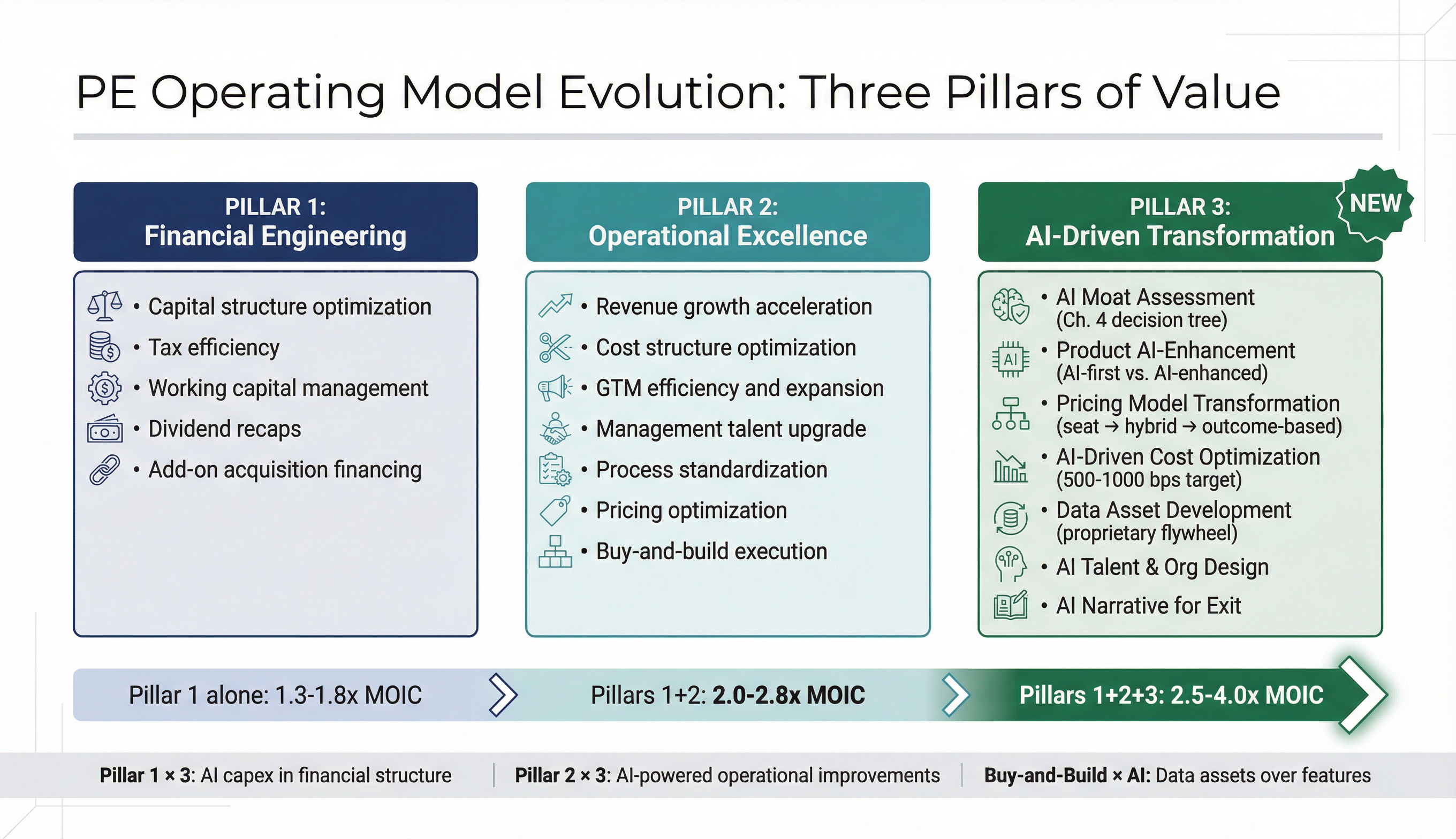
Vista Equity Partners — with $100 billion in AUM and 90+ portfolio companies — has created an "Agentic AI Factory" to deploy AI across its companies. Thirty companies are already generating revenue from AI transformation, with another 30–40 converting. Vista reports productivity gains of 30–50% in writing code and $10 in savings for every $0.20 of inference cost.
Every PE SaaS acquisition must now include:
- AI Moat Assessment using the decision tree — classifying targets as Fortress, AI-Enhanced Winner, Adapter, or Exposed
- NRR Decomposition — AI disruption shows up in net revenue retention 12–18 months before it hits EBITDA
- Seat-Reduction Stress Tests — model 15%, 30%, and 50% seat-count declines
- Pricing Model Migration — if >80% revenue is per-seat, price the transition risk into entry valuation
- Competitive Threat Mapping — not just SaaS competitors, but AI-native disruptors and customer build-vs-buy risk
The target: 500–1,000 basis points of EBITDA margin improvement within 24 months from AI-driven automation — but with 30–50% of savings reinvested into revenue-expanding AI capabilities. Cost savings alone are a trap.
Three Traps That Destroy Value
Trap 1: Overpaying for Feature-Based Differentiation
AI has collapsed the feature replication cycle from years to days. Any specific AI feature you spend six months building can be replicated by a competitor with a prompt. PE funds paying 10x+ for companies whose differentiation is primarily feature-based are overpaying for an evaporating asset.
The test: "Could a well-funded competitor replicate this feature set in 12 months using AI tools?" If yes, the premium is unjustified.
Trap 2: Assuming AI Cost Savings = Automatic Value Creation
PwC's 2026 survey of 4,454 CEOs: 56% saw neither increased revenue nor decreased costs from AI. Only 12% reported both. Separately, MIT research found that 95% of generative AI initiatives fail. The problem is organizational, not technological — and PE-driven cost-cutting approaches are uniquely ill-equipped to solve it.
Trap 3: Treating All SaaS as Equally Exposed (or Equally Safe)
Some PE funds are avoiding SaaS entirely — missing opportunities to buy defensible platforms at trough multiples. Others are dismissing AI risk because "our EBITDA looks fine this quarter" — ignoring that NRR degradation precedes EBITDA impact by 12–18 months.
The correct posture is neither panic nor complacency — it is rigorous, company-by-company assessment.
What "Good SaaS" Looks Like in 2030
Our research converges on eight characteristics that define the premium PE SaaS investment at the end of this cycle:
- Owns the system of record for a specific vertical or function
- Generates proprietary data that AI agents need and cannot replicate
- Has migrated to hybrid pricing — ~60% base subscription, ~40% usage/outcome-based
- Gross margins of 65–75% — lower than legacy SaaS due to inference costs, but offset by operating leverage
- NRR above 120% driven by AI-powered upselling and usage expansion
- Operates in a regulated environment creating compliance-driven switching costs
- Competitive position strengthened by AI, not despite it
- Positioned for premium exit — to strategic acquirers, sponsor-to-sponsor, or public markets
The Bottom Line
The SaaS era is not ending. It is being rewritten. The global SaaS market is projected to reach $800–900 billion by 2030, growing at 12–19% CAGR. But the distribution of that value is changing more dramatically than at any point in the industry's history.
The firms that invested in cloud SaaS during the skepticism of 2008–2012 — when "cloud" was dismissed as immature, insecure, and unproven — captured a generational return. Salesforce traded below 4x revenue in 2008; it peaked above 15x in 2021.
The AI-era equivalent of that opportunity exists today. Post-sell-off multiples of 3.5–5.5x for companies matching the winning archetypes represent the deepest discount to intrinsic value since the pre-pandemic era.
What remains is the conviction to act — and the frameworks to act with precision.
The firms that wait for clarity will find that clarity arrives priced in.
This article is an executive briefing from JABB Fusion's comprehensive research report "SaaS in the AI Era: A Five-Year Private Equity Playbook." The full report includes 9 analytical chapters, quantified valuation scenarios, detailed PE operating playbooks, company-specific case studies with verified financial data, and complete source references.
Generated by JABB Fusion Deep Research — AI-orchestrated, human-QA'd analysis for investment professionals.
Want the full picture?
This briefing covers the highlights. The full 9-chapter report includes detailed valuation models, PE operating playbooks, company-specific case studies, and 200+ verified sources.
Read the Full Research Report